
Unconventional Book Launches
The three unconventional things authors must do before launching a book

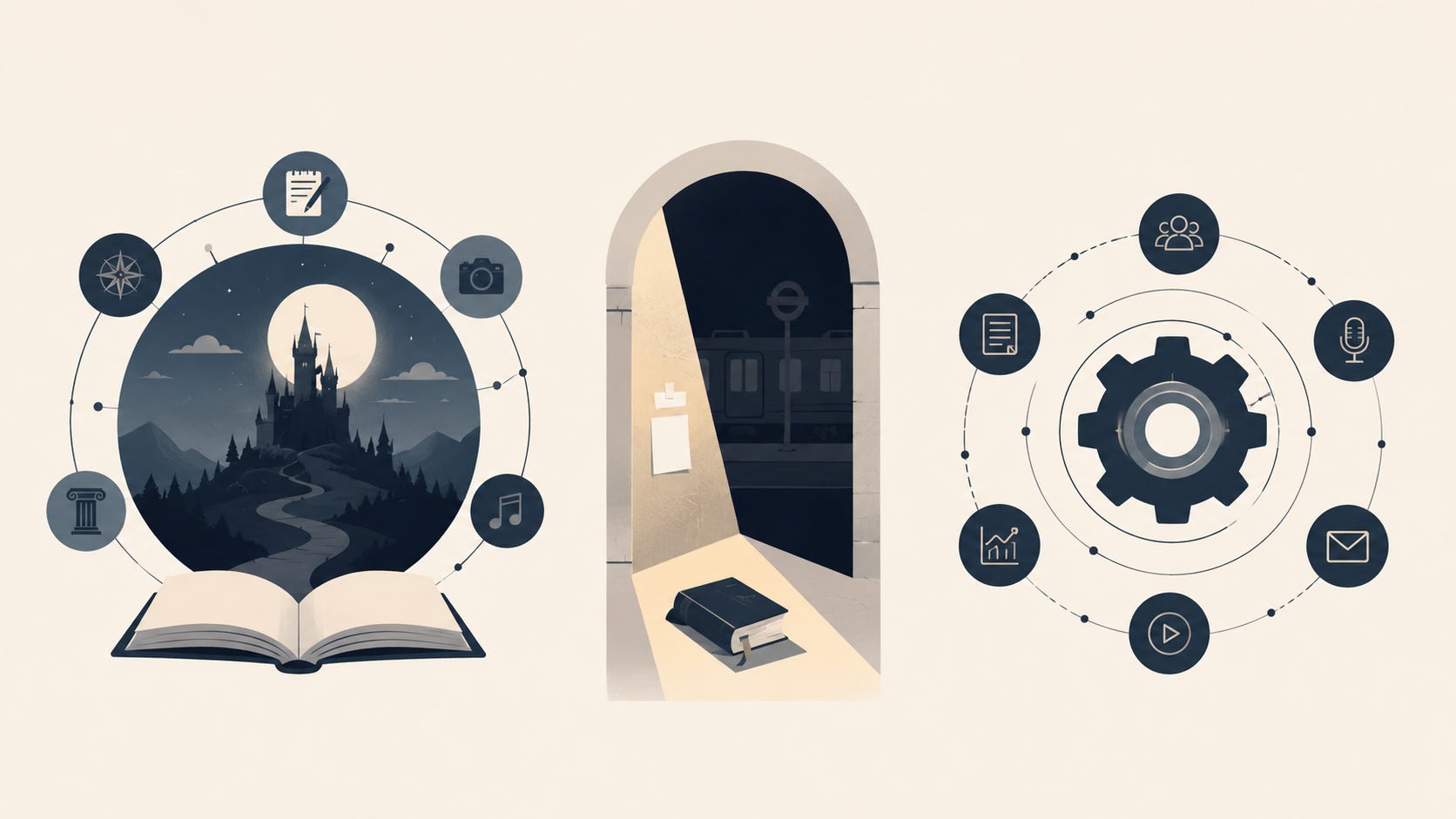
Most book launches fail long before release day.
Many authors spend two or three years writing a book and only a few weeks preparing readers to care about it.
The result is predictable: a brief spike of attention followed by rapid disappearance.
Modern publishing rewards books that create ongoing conversations, communities, aesthetics, and curiosity long before (and long after) launch week.
Here are three unconventional things authors should do before releasing a new book.
1. Build the world around the book before the book exists
Most authors wait until launch season to start talking about their book.
That’s usually too late.
Readers don’t instantly care about an unfamiliar title from an unfamiliar author. Attention has to be earned gradually through themes, interests, atmosphere, and curiosity.
The strongest launches often begin months earlier through adjacent content. For fiction authors this would look like:
essays
lore posts
aesthetic videos
research threads
trope discussions
playlists
mythology
location photography
genre commentary (become an expert in your genre and post about it — see this example)
“books like…” recommendations
behind-the-scenes worldbuilding
At that point, readers are no longer discovering “a random new release.” They’re entering an atmosphere they already recognize and enjoy.
For example, for my upcoming urban fantasy novel, Dark Stations, I post book recommendations on particular genres or tropes and include my book alongside well known books. Check out this one.
Nonfiction authors can build the same kind of ecosystem, but the entry points are usually ideas rather than atmosphere.
Readers discover nonfiction through problems, frameworks, questions, and identity. A nonfiction launch can begin months earlier through:
essays
contrarian takes
case studies
research breakdowns
annotated examples
behind-the-scenes process posts
podcast conversations
industry commentary
frameworks
visual diagrams
reader challenges
live experiments
curated resources
A business book about AI and thought leadership, for example, should already be generating conversations around positioning, automation, visibility, creator economics, or personal branding long before release day.
The goal is similar to fiction: readers should feel they are already participating in the author’s intellectual world before the book becomes available.
Authors who understand this stop thinking like publishers and start thinking like world-builders.
The book becomes the centre of a larger gravitational field.
2. Engineer physical-world discovery
The internet is crowded with content of all sorts as everything is digital.
Physical reality feels different.
That imbalance creates an unusual opportunity for indie authors willing to think differently.
Offline discovery has become memorable precisely because so few creators use it anymore.
Imagine finding:
a cryptic bookmark inside a café book exchange
a mysterious QR code poster in a Tube station
free mini-editions left in public places
fictional “artifacts” from a story world
a fantasy publisher flyer hidden in an indie bookshop
eerie location videos filmed where the story takes place
Those moments feel real in a way digital advertising often doesn’t.
For genres like fantasy, horror, magical realism, and supernatural suspense, physical discovery can amplify immersion. The boundary between fiction and reality becomes slightly blurred.
That emotional effect is difficult to replicate with standard social media promotion.
Physical-world discovery also creates stories people want to share online:
“Look what I found today.”
Meanwhile, many authors are still posting generic graphics that disappear into the algorithm within hours.
Readers remember experiences more than advertisements.
Especially in an age where nearly everything feels temporary and digital.
Want to join the launch team for my upcoming novel Dark Stations?
Early readers will get a free advance copy, behind-the-scenes updates, and the chance to participate in the book launch.
Here’s the story you’ll be reading:
What if the dead began riding the London Underground?
When a grieving father sees the ghost of his daughter on the Tube, he follows her into Dark London—a shadow version of the city ruled by Grief itself.
Now he must confront the guilt that haunts him and rescue her from an afterlife she was never meant to enter… before he fades into a ghost himself.
But in Dark London, far more is at stake than he ever imagined.
A haunting urban fantasy about grief, redemption, and the love between a father and daughter that refuses to die.
👻 If you love urban fantasy, hidden worlds, and emotional supernatural stories, get started here.
3. Build the post-launch engine before launch day
Many authors secretly view launch day as the finish line.
In reality, launch day is the start of the real campaign.
The first week only tells you whether the engine turns on.
What matters more is whether the book remains visible after the initial burst of attention fades.
This is where many launches collapse.
The author spends months preparing:
ARC distribution
cover reveals
countdown posts
release announcements
Then the book launches… and the marketing suddenly stops.
Momentum disappears fast online. Algorithms move on. Readers become distracted. New releases bury older ones almost immediately.
A serious launch strategy requires preparing the second phase before release even happens.
That means building:
30–60 days of content
evergreen SEO articles
follow-up videos
BookTok hooks
podcast appearances
newsletter sequences
reader funnels
review outreach
discussion prompts
seasonal angles
ad experiments
cross-promotions
bonus content
The authors who sustain momentum are usually the ones who prepared for endurance instead of excitement.
A launch should behave more like a campaign than a single event.
This becomes even more important for indie authors because backlist strength often determines long-term income more than launch-week performance.
A book that keeps circulating six months later is far more valuable than one that briefly spikes and disappears.
Publishing culture tends to obsess over release week rankings, preorder numbers, and launch-day screenshots. Those metrics feel emotionally significant because they’re immediate and visible.
Long-term discoverability matters more.
Especially now.